
When Doing More Doesn't Mean Doing Better: Making Decisions for Your Neurodivergent Family

I don't know about you, but I often feel like I'm not doing enough.
As a parent of neurodivergent children, I can feel bombarded with information about what I should or could be doing to help. There is always another article, podcast, social media post or expert telling me about something else that might support my children: more exercise, better sleep, more time outdoors, the right food, better routines, therapy, occupational therapy, strategies for emotional regulation, strategies for executive functioning... the list can feel endless.
And then there are the comparisons.
I hear about children at school who are doing music, tutoring, swimming, football, dance and a whole host of other activities every week. Meanwhile, I'm sometimes quietly celebrating if we've made it through a full day of school.
I can find myself wondering whether I'm doing enough.
Am I giving my children everything they need? Am I missing something important? Am I doing enough now to give them the best chance of becoming happy, confident adults?
I know I'm not the only parent of neurodivergent kids who carries some version of these questions. And sometimes, that bombardment of information, worry and overwhelm makes it very difficult to know when to say yes.
When something good still doesn't work
Swimming is a good example for me.
My son is a great swimmer. It's one of his strengths, and he really enjoys being in the water. We aren't able to do swimming lessons at the weekend at the moment, so I asked him whether he'd like to do them after school one day. He said yes, so we booked the lessons.
And they didn't go well.
In fact, it was a disaster.
At first, I found myself trying to make it work. Swimming is good for him. It's something he's good at, it gives him exercise, builds his confidence and can support his emotional regulation. Most importantly, he wanted to do it.
So surely we just needed to find a way to make it work?
But the reality was that his capacity was already pretty stretched after school.
Then there was the added sensory experience of winter swimming: going from warm clothes into cold water, being outside in the cold, getting warm again in the pool and then having to get out of the warm water, get changed while wet and cold, and come home.
It was a lot.
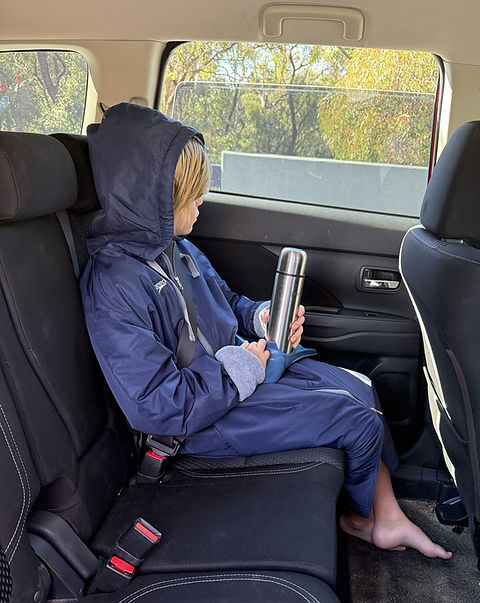
I tried to make it easier. I started taking a flask of hot chocolate with us for afterwards, hoping that a little warmth and comfort would help. I bought him a really cosy swim parka. But even with those adjustments, it wasn't really working for our family.
Eventually, I had to acknowledge something that can be surprisingly difficult as a parent:
A good activity isn't necessarily a good activity for us right now.
When "could" becomes "should"
I think this is where parenting neurodivergent children can become particularly complicated.
There are so many things that could help our children. And when you care deeply about giving your child the best possible support, it's very easy for "could" to turn into "should".
They could do swimming, so perhaps they should do swimming. Exercise could help their executive function, so perhaps we should be doing more exercise. This therapy could help, so perhaps we should find a way to fit it in. Another activity could build confidence, so maybe we shouldn't let them miss out.
Before long, you can find yourself trying to fit an enormous number of potentially beneficial things into a family that has a finite amount of time, energy and capacity.
And that's the part we can easily overlook.
Something can be beneficial and still not be the right choice for your family right now.
Every decision has a cost
Every decision we make has a cost. Not necessarily a financial cost. It might be time, energy, sensory load, emotional regulation, recovery time, sleep, family connection, or simply the capacity to get through the rest of the week.
Swimming lessons had genuine benefits for my son. But the short-term impact of doing them after school was too much. His nervous system was already working hard, his capacity for everything else was stretched, and the lesson was taking more from him than it was giving.
That doesn't mean swimming is wrong for him.
It means swimming lessons after school, in winter, aren't working for our family right now.
And that distinction matters.
If we only look at whether something is "good for ADHD", we can miss the bigger picture.
The question isn't just, Is this a good thing?
It's: Is this a good thing for this child, for this family, at this time, in this way?
Looking at now and longer term
This has also made me think about the difference between what something costs us now and what it might give us longer term.
Sometimes a decision is difficult in the short term but the longer-term benefits make that difficulty worthwhile. Starting a new therapy, changing schools or trying something outside a child's comfort zone might all involve an initial increase in stress or demand. That doesn't necessarily mean we shouldn't do them.
Other times, something can be difficult in the short term without offering enough longer-term benefit to make the cost worthwhile.
And sometimes the potential long-term benefit is real, but the way we're trying to achieve it simply doesn't fit our family's current capacity.
That's how I now think about the swimming lessons.
I don't have to decide that swimming is either "good" or "bad" for my son. I can recognise that this particular version of swimming, at this particular time, isn't working.
Perhaps swimming lessons will work on a Saturday in the future. Perhaps they'll work in summer when the sensory experience is different. Perhaps his overall capacity will change.
It doesn't have to be a forever decision.
Sometimes the answer is simply not now.
So how do we decide?
This is why I created my Neurodivergent Family Decision Filter.

I wanted something simple that would bring me back to what actually matters to our family when I'm overwhelmed by all the things we could be doing.
Instead of asking only, "Is this a good thing for my child?", I can step back and ask:
"Is this a good thing for our family, at this time, in this way?"
My four filters are Attending School, Nervous System Regulation, Family Capacity and Happiness. I've also included space for your own filter, because what matters most will be different for every family.
I then consider both the impact now and the potential impact longer term.
This helps me see the whole picture.
An activity might be difficult now but offer significant longer-term benefits. Another might look wonderful on paper but have a much bigger impact on family capacity than I'd initially realised. Something else might support one child but make the rest of the family's week much harder.
The Decision Filter isn't designed to tell me what I should choose.
It's there to slow me down enough to make a decision based on our family's needs and values rather than guilt, comparison or the endless list of things we could be doing.
Want your own copy of the Neurodivergent Family Decision Filter?
If you find yourself constantly wondering "Are we doing enough?", I've created a printable version of my Neurodivergent Family Decision Filter that you can use when you're considering a new activity, therapy, commitment or opportunity.
It's a simple way to step back from the overwhelm and think about what actually fits your family, your values and your capacity right now.
Get your free Decision Filter → HERE
I'll send the printable straight to your inbox.
You don't have to do everything
I still get caught up in comparison.
I still see families whose children seem to be doing everything and wonder whether I'm doing enough. I still read something about ADHD or autism or anxiety or dysgraphia and occasionally think, Oh, maybe we should be doing that too.
But I'm learning to pause.
Because my children don't need me to find every possible thing that could help them.
They need me to understand them.
To notice their capacity. To pay attention to what is actually working. And sometimes, that means letting go of something that is objectively beneficial because the way we're trying to do it isn't benefiting them right now.
That's not failing. It's not giving up.
It's responding to the child in front of me.
And perhaps that's one of the most important things I've learnt as a parent of neurodivergent children:
Doing more isn't always doing better.
Sometimes the most supportive thing we can do is create enough space for our children (and ourselves) to breathe.
If you're tired of wondering whether you're doing enough
If you're constantly questioning your decisions, feeling overwhelmed by all the things you could be doing, or struggling to work out what actually works for your family, this is exactly the kind of thing I help parents work through in my strength-based ADHD and AuDHD coaching.
If what you've read here resonates with you, you're welcome to book a free 15-minute discovery call with me.
There's no obligation to continue. It's simply an opportunity for us to talk about what's going on and see whether coaching could be helpful for you.
Book your free 15-minute discovery call → HERE
Your family doesn't need to do everything.
It needs to find what works for you.


Comments